Interessado na PrEP, mas com dúvidas? Esta página é para ti.

O que é a profilaxia pré-exposição (PrEP)?
A profilaxia pré-exposição (PrEP) ao HIV é uma estratégia que consiste na administração de terapêutica antirretroviral em indivíduos não infetados, que estejam expostos a situações de alto risco, com o objetivo de prevenir esta infeção. Em Portugal, o único esquema aprovado até ao momento para PrEP consiste na toma de comprimidos.
É necessário acompanhamento médico para fazer PrEP?
O acompanhamento médico é imprescindível para usar a PrEP de forma segura e eficaz. Este acompanhamento envolve uma avaliação inicial de saúde, incluindo antecedentes pessoais e medicação, bem como a aferição dos critérios para o seu início, solicitando os meios complementares de diagnóstico necessários.
A PrEP é indicada apenas para pessoas que não têm infeção por HIV, pelo que utilizar a PrEP sem essa confirmação, ou sem essa monitorização regular, pode gerar resistência do vírus, caso a pessoa já esteja infetada.
Além disso, o acompanhamento médico permite a orientação acerca do uso correto da medicação, monitorizando possíveis efeitos colaterais ou toxicidade.
O que acontece se o meu teste HIV for positivo?
A infeção nos utilizadores de PrEP são raras, sobretudo quando há boa adesão à medicação e às consultas médicas. Um teste positivo para HIV deverá sempre ser repetido para confirmação do diagnóstico.
A confirmar-se, a equipa médica prestará todo o aconselhamento e auxiliará na referenciação à consulta hospitalar de Doenças Infecciosas.

Eficácia e Segurança
Sim, os estudos demonstram que a PrEP é eficaz na prevenção da infeção por HIV, tornando a infeção pelo virus improvável quando há boa adesão ao regime.
Não, os estudos demonstram que são necessários alguns dias para que os fármacos atinjam as concentrações necessárias para conferir proteção contra o HIV.
Assim, no esquema convencional, a PrEP deverá ser iniciada 7 dias antes da primeira exposição de risco e interrompida 7 dias após a última exposição. É fundamental o uso do preservativo e/ou de outros métodos de prevenção durante esses períodos.
Sim, a PrEP é segura. No entanto, por forma a garantir esta segurança, é necessária a adesão da pessoa à avaliação regular em consulta e à realização dos testes solicitados.
Se tomada corretamente, a PrEP é uma terapêutica geralmente bem tolerada; foram identificados alguns efeitos adversos, como náuseas e vómitos, diarreia, flatulência, cefaleias, e tonturas. Estes são normalmente transitórios.
De forma infrequente, a sua utilização pode ainda causar toxicidade renal e/ou óssea, pelo que é necessária uma vigilância contínua durante o tratamento.
Todos estes efeitos adversos são cuidadosamente monitorizados através do acompanhamento médico prestado.
A proteção conferida pela PrEP é exclusivamente ao HIV, e depende da adesão à mesma, não sendo extensível a outras ISTs, preveníveis através do uso do preservativo interno ou externo, vulgo feminino ou masculino.
No entanto, qualquer estratégia de prevenção da infeção por HIV faz parte de uma abordagem combinada e integrada na abordagem de prevenção de outras IST.
O acompanhamento médico prestado engloba a realização de rastreios para deteção e tratamento precoce de ISTs, nomeadamente sífilis, gonorreia, clamídia e hepatites.
A prevenção de ISTs engloba uma abordagem combinada que engloba o uso do preservativo, a avaliação do consumo de substâncias, a deteção e tratamento precoce de IST e atualização do estado vacinal.
Existem ISTs preveníveis através da vacinação, como as hepatites A e B, Mpox ou HPV.
No acompanhamento médico realizado serão prestadas recomendações acerca das vacinas sugeridas para conferir maior proteção contra ISTs.
A DoxyPEP é uma estratégia de prevenção que consiste na toma de doxiciclina após uma relação sexual, com o objetivo de reduzir o risco de algumas infeções sexualmente transmissíveis (IST) bacterianas, sobretudo sífilis e clamídia.
Não protege contra o HIV nem contra outras IST, como hepatites virais, e a proteção contra a gonorreia é limitada e variável.
Além disso, o uso de antibióticos pode contribuir para o desenvolvimento de resistências antimicrobianas, pelo que a DoxyPEP não deve ser utilizada de forma indiscriminada.
Em Portugal, não está atualmente aprovada como estratégia universal de prevenção das IST, pelo que a sua utilização deve ser avaliada caso a caso por um médico, considerando o risco individual e os potenciais benefícios e riscos.
A PrEP (profilaxia pré-exposição) é uma estratégia de prevenção do HIV que consiste na toma de medicação antirretrovírica antes de uma possível exposição ao vírus. É indicada para pessoas com risco aumentado de adquirir HIV e, quando tomada corretamente, reduz significativamente o risco de infeção.
A PEP (profilaxia pós-exposição) é uma medida de prevenção de emergência, utilizada depois de uma possível exposição ao HIV. Consiste na toma de medicamentos antirretrovíricos durante 28 dias e deve ser iniciada o mais rapidamente possível, idealmente nas primeiras horas e nunca depois das 72 horas após a exposição.

Devo fazer PrEP?
A decisão de iniciar a PrEP depende essencialmente do risco individual de contrair a infeção pelo HIV.
A PrEP destina-se a adultos sexualmente ativos e com risco acrescido de infeção por HIV, designadamente aqueles que:
- Têm relações sexuais sem preservativo com frequência e:
- Não sabem se os/as parceiros/as têm HIV;
- Os/as parceiros/as têm HIV, mas não estão a fazer tratamento de forma eficaz ou regular;
- Tiveram recentemente uma infeção sexualmente transmissível;
- Já precisaram de tomar medicamentos de emergência contra o HIV (PPE) e continuam a correr riscos;
- Utilizam substâncias psicoativas durante o sexo.
- Querem engravidar ou estão grávidas e têm um/a parceiro/a com HIV mal controlado;
- Têm relações sexuais em troca de dinheiro, bens ou drogas, sem utilizar sempre preservativo;
- Usam drogas injetáveis e não utilizam sempre material esterilizado;
Não. O risco de aquisição de HIV é determinado conjuntamente pela frequência de práticas sexuais, pelo tipo de práticas e a probabilidade de o/a parceiro/a sexual ter HIV.
De acordo com a probabilidade estimada de adquirir infeção por HIV por cada ato sexual, o risco acrescido ocorre nas relações anais recetivas, seguindo-se da relação anal insertiva, relação recetiva peniana-vaginal e relação insertiva peniana-vaginal, sendo baixa no sexo oral recetivo ou insertivo.
O risco de adquirir HIV é mais elevado nos casos de coinfeção com outras IST e particularmente na presença de infeção aguda de algum dos parceiros.
Sim, nomeadamente:
- Serologia positiva ou desconhecida para o HIV;
- Presença de sinais ou sintomas de infeção aguda por HIV;
- Alterações da função renal;
- Reação adversa a algum dos componentes da medicação.
Na primeira consulta médica é avaliada a situação clínica e são prescritos os meios complementares de diagnóstico necessários para excluir as contraindicações referidas e iniciar PrEP com vigilância e segurança.
Indicações sobre a Utilização
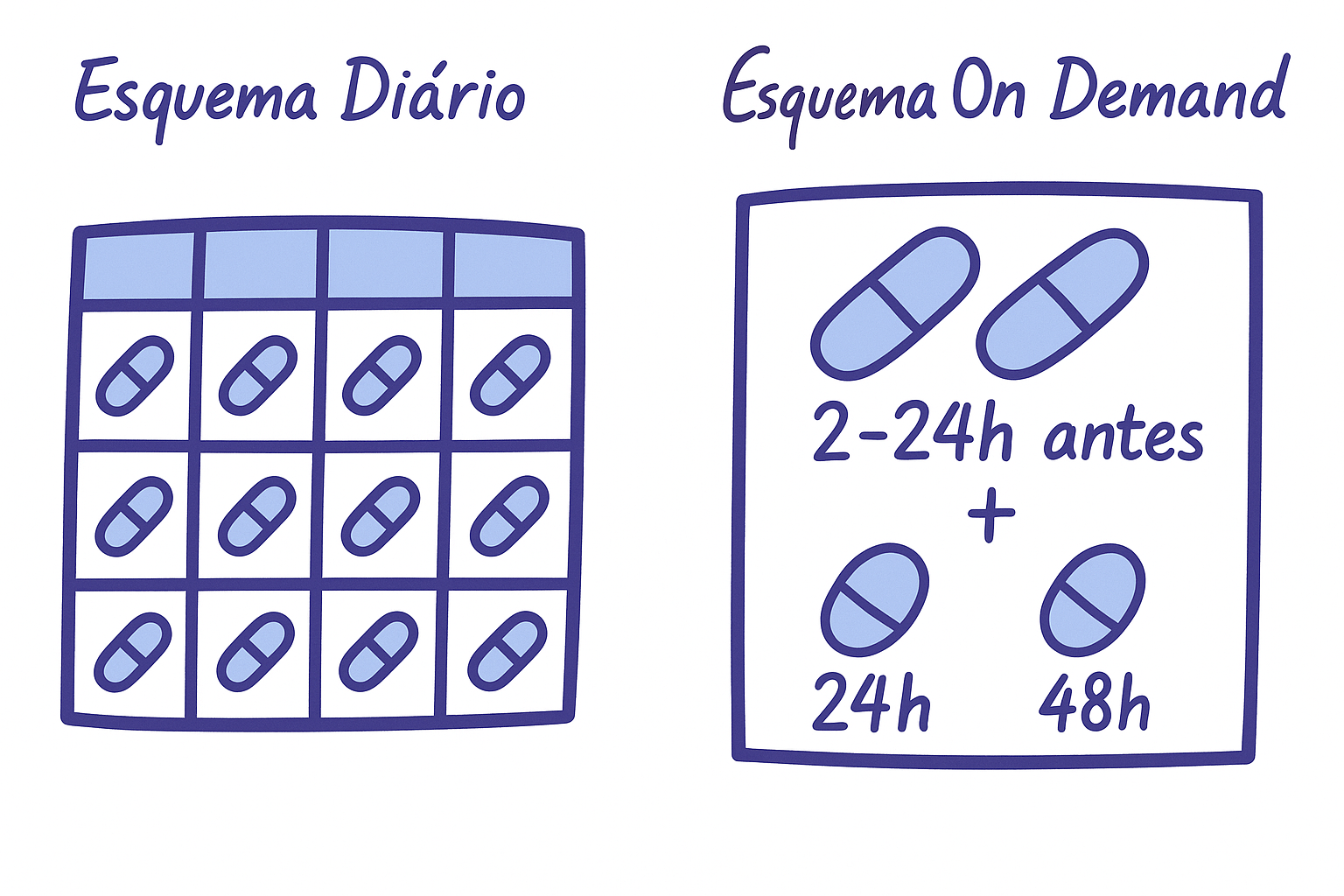
A PrEP pode ser realizada de forma diária, na dose de 1 comprimido/dia, ou, em determinados casos, de forma intermitente (on demand), na dose de 2 comprimidos pelo menos 2h antes da exposição, 1 comprimido às 24 horas e outro às 48h após a exposição, num total de 4 comprimidos.
O esquecimento pontual de uma toma, no esquema diário, não compromete a eficácia da profilaxia. No entanto, dependendo do número de esquecimentos por semana, poderão não ser cumpridos os requisitos para manter a eficácia da PrEP.
Na consulta inicial, a nossa equipa médica explicará todos os procedimentos a realizar nesses casos.
Para evitar esquecimentos, é boa ideia combinar a toma com uma atividade diária rotineira, como o pequeno-almoço ou a lavagem dos dentes, bem como manter comprimidos suplentes em locais como o trabalho, a casa de um parceiro habitual, a pasta ou a mochila.
Antes de viajar com a PrEP deve-se verificar se os países de destino e de escala permitem transitar com medicação antirretroviral, pois existem restrições em determinados locais (exemplo Abu Dhabi, Dubai, Qatar). É aconselhável transportar a medicação na bagagem de mão, com a respetiva prescrição médica/declaração.
Caso necessites, temos disponível uma Consulta de Viajante para te ajudar.
Sim, há determinados fatores que requerem a suspensão da PrEP, nomeadamente:
- No diagnóstico de infeção por HIV;
- Intolerância à medicação ou aparecimento de problemas nos rins ou ossos;
- Quando o/a utente deixa de tomar a PrEP corretamente ou não comparece às consultas e análises;
- Se a própria pessoa decidir parar;
- Quando já não há comportamentos de risco e não se espera haver risco nos próximos 3 meses;
- Em grávidas, se os riscos da PrEP forem maiores do que os benefícios.
Sim, a PrEP pode voltar a ser iniciada quando voltar a existir indicação clínica.
Sim, a maioria dos suplementos pode ser tomada em segurança juntamente com a PrEP. No entanto, se tomas creatina ou suplementos de proteína, deves informar o médico que te acompanha.
Durante a PrEP, é feita regularmente uma análise à creatinina, que ajuda a avaliar a função renal. A creatina e alguns suplementos de proteína podem alterar os valores da creatinina no sangue e fazer parecer que a função renal está alterada, mesmo quando os rins estão a funcionar normalmente. Diz sempre ao médico quais os suplementos que tomas, para que os resultados das análises possam ser corretamente interpretados.
A maioria dos medicamentos pode ser tomada em segurança com a PrEP. É especialmente importante ter atenção a medicamentos que podem afetar os rins, como alguns anti-inflamatórios (por exemplo, ibuprofeno ou diclofenac). O uso pontual é seguro, mas doses elevadas ou uso prolongado podem aumentar o risco de toxicidade renal. Alguns antivirais, como o valaciclovir, utilizado no tratamento do herpes, e os aminoglicosídeos também podem afetar a função renal. Existem ainda outros medicamentos e tratamentos com potencial de toxicidade renal que devem ser avaliados caso a caso.
Posso utilizar poppers, drogas recreativas ou medicamentos para disfunção erétil enquanto tomo PrEP?
Não são esperadas interações diretas entre a PrEP e o uso de poppers, drogas recreativas (como cannabis, MDMA/ecstasy, cocaína ou metanfetamina) ou medicamentos para disfunção erétil. Isto não significa que o consumo seja isento de riscos. Algumas destas substâncias podem aumentar outros riscos para a saúde sexual e dificultar a toma correta da PrEP. Fala sempre com o teu médico sobre o que consomes ou tomas, para que possa aconselhar-te de forma segura.